Exploring a Complex World in Context

Since its founding, the University of Tennessee, Knoxville, has offered students a rich education that weaves together various branches of study, growing not only knowledge but curiosity, collaboration, and creativity.
Today faculty in the College of Arts and Sciences are leading, creating, and adapting courses that engage students in understanding complexities of the past and present while preparing them to navigate a future as-yet unimagined.
Preparing Global Citizens
It would be easy for students to take for granted the access they have to products and cultures from around the world.
“Most of our students grew up in a world that was shaped by globalization processes that began in a very accelerated way in the late 1970s and we are now, today, living in the aftermath of those,” said Nathan Reeves, a historian, musicologist and postdoctoral associate in the Department of Sociology. “We are seeing the long-term reaction to those processes; they’re unfolding before our very eyes in the news every day.”
Reeves teaches Introduction to Global Studies with Teaching Assistant Professor Anthony J. (AJ) Knowles, who is also a postdoctoral researcher in UT’s Center for Transportation Research.
The course takes a multidisciplinary and interdisciplinary approach to investigating how the world works. While required for global studies majors, the course enables students in any field to envision how global processes affect their career goals and to develop critical thinking skills.
“It provides an opportunity for students with different perspectives to engage in frank conversations about how and why the world works the way it does. How did we get here? What have been the consequences of globalization in our present world, and how can we imagine solutions moving forward,” Knowles said.
Multiple Perspectives
Students in the course have the advantage of faculty members with different areas of expertise.
“I focus mostly on politics and economics, primarily looking at things such as the global value chain of the Apple iPad or shipbreaking practices in Bangladesh, or the development and spread of electric vehicles, whereas Nathan focuses on topics ranging from the popularity of K-pop or the Slow Food movement,” Knowles explained.
The course also may feature up to half a dozen guest lectures. James Newburn, managing director of UT Gardens Knoxville, has taken students through the globalization of the fresh cut flower industry, from tulips picked in Amsterdam to their arrival in local grocery stores in a day or two, an opportunity to examine topics from efficiency to environmental costs. Assistant Professor Florence Dery from the Department of Africana Studies discusses her research on public health in Ghana and the impact of climate change and the availability of water.
Last fall, Palestinian composer Ramzi Aburedwan, the 2025 Natalie L. Haslam Distinguished Artist in residence at the UT College of Music, told global studies students about his experiences growing up in a refugee camp and teaching children in the occupied territories.
With the expertise in the College of Arts and Sciences faculty alone, the course provides depth for discussing topics in the news.
Knowles, who published a book in 2025 about the transformations of labor in the US and German auto industries, updated his lecture on the auto industry to examine the potential impact of tariffs.
“Sometimes we’re able to invite speakers and discuss topics that directly relate to what’s happening in the news on a daily basis, and I think that’s really exciting for students,” Reeves said.
For example, Associate Professor Timothy M. Gill, director of the global studies program, discussed US foreign policy in Venezuela, and Assistant Professor Vasabjit Banerjee, a comparative political scientist, discussed Guyana, which is involved in a territory dispute with its neighbor involving oil.
During integration days, the students work on projects that build on what they’ve been learning from the guest lectures and discuss different aspects of a topic. After Gill and Banerjee’s lectures, one group examined how different international oil companies were presenting their interests in the region, and another explored the impact of an International Court of Justice ruling on elections in the disputed region.
Students also research the globalization of topics they choose. So, for example, one wrote about how Western concepts of anatomy charts were received and adapted in Japan, and another examined heavy metal music and religious tensions in Germany, the US, and Indonesia.
In unprecedented times, Reeves said, “one thing that I communicate to students is we don’t yet have the benefit of historical hindsight, but we can use our critical thinking to make sense of what’s happening around us.”

Knowles said, “They don’t just come away from the course understanding a few different things about culture or about music, or about manufacturing, or about politics. They have an integrated, interdisciplinary understanding of a variety of topics that all hit in one way or another upon this concept of globalization. What we’re really doing is giving so many different examples from so many different lenses and perspectives that you have a more holistic, comprehensive, interdisciplinary grasp of the concept.”

Connecting Through Communication
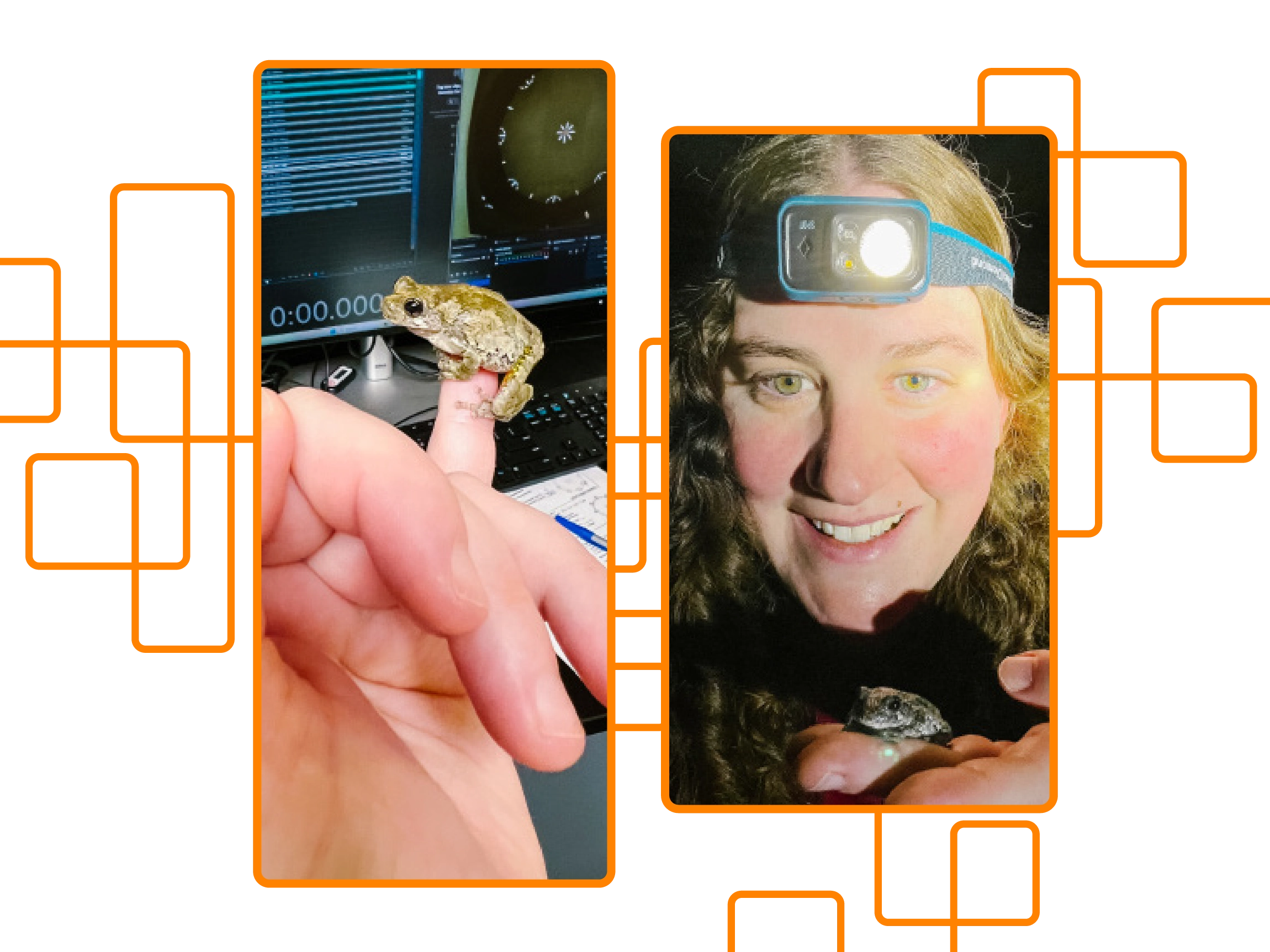
Another course that would be impossible to teach without an interdisciplinary approach is Animal Communication, listed in the catalog as a course under two departments, psychology and neuroscience, and ecology and evolutionary biology.
“Animal behavior in general, and animal communication in particular, draw on concepts from physics and chemistry, economics, psychology, ecology and evolutionary biology, developmental biology, neuroscience, and more,” said Assistant Professor Jessie Tanner from the Department of Ecology and Evolutionary Biology (EEB).
“Animal signals are physical phenomena, like waves or chemicals, that we can study using principles from physics and chemistry,” she continued. “Signals move through a medium, like air or water, according to principles of physics. Animals have to receive those signals, which they do using interesting mechanisms of hearing, vision, etc., and we borrow concepts from cell biology and neuroscience to understand those things. Animals behave with one another according to rules that can be modeled using behavioral economics, so we apply concepts from that literature. Human language is a very special case of animal communication that also evolved, like other kinds of animal communication. The study of language and how it evolves is the domain of linguistics and evolutionary anthropology. We draw on principles from all these fields and more in our readings, discussions, and assignments.”
Students also are asked to think across and between levels of explanation for a phenomenon, from neural mechanisms to evolutionary processes. “We’re constantly going from the very proximate to the very ultimate,” explained Assistant Professor Alejandro Vélez Melendez from the Department of Psychology and Neuroscience, who also teaches the course.
Beyond studying how communication happens and evolves, students design experiments and think critically about data, developing reasoning skills that will serve in preparing for the MCAT exam or a number of future careers.
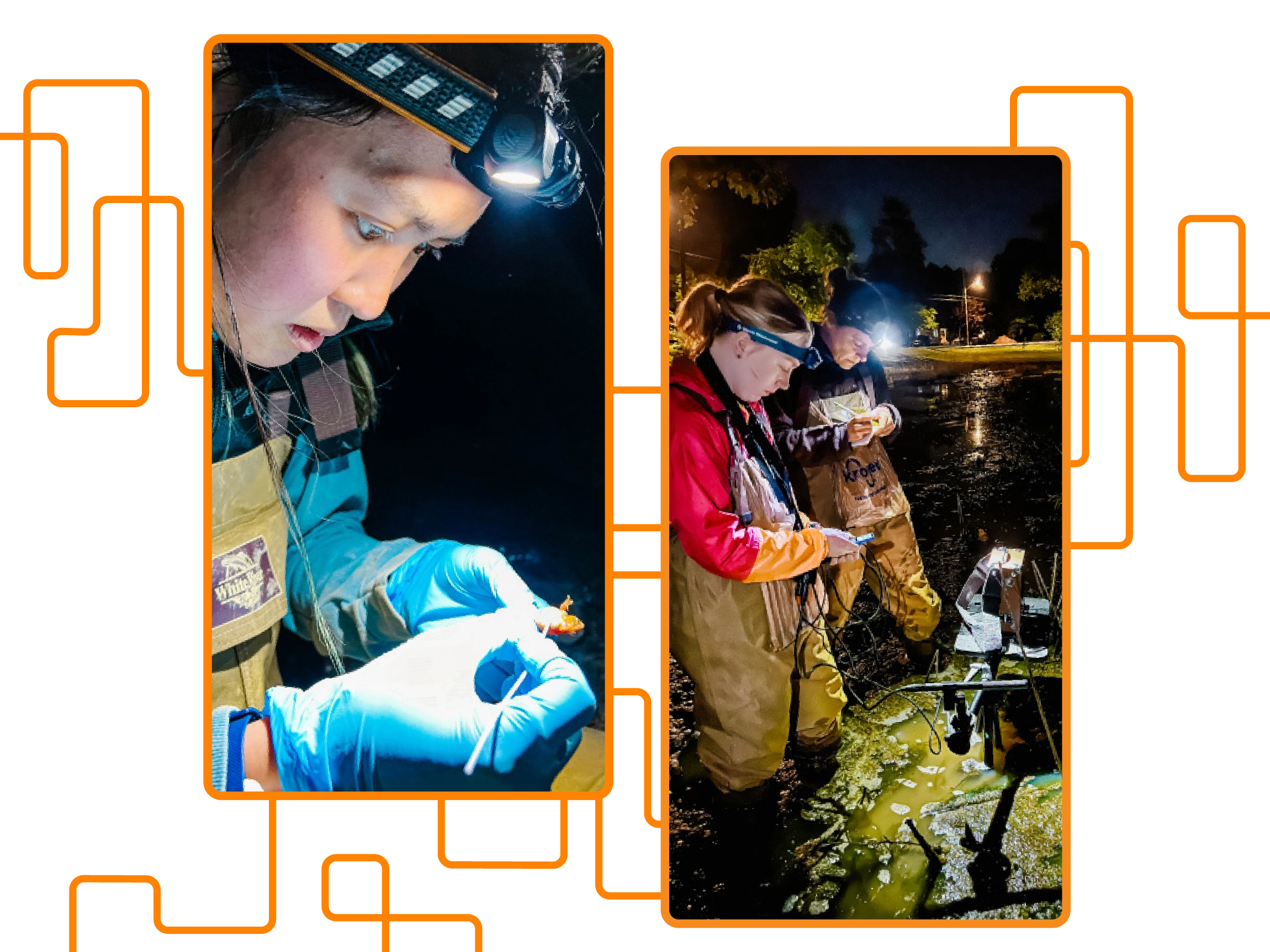
His students, for example, conduct a research experiment that includes recording bird songs on the Knoxville campus and analyzing the sounds with software used by psychologists and cognitive neuroscientists.
Students are sometimes surprised to realize that research they are reading for the course was published by UT faculty members such as psychology and neuroscience Professor Todd Freeberg and EEB Professor Elizabeth Derryberry.
“One of the most exciting things about getting an education at an R1 research intensive university is you get to meet the people who are truly at the forefront of their field, and they’re doing active research in the topic,” Tanner said.
Many students have never met scientists or considered research opportunities. “You can introduce people to those kinds of role models and open their eyes about what sorts of careers there might be in their chosen field.”
She knows, however, that not all of the students in the course will become animal communication biologists. Tanner notes that animal sounds are one of the first things that little children learn, and she hopes UT students come away from the course with a sense of awe and beauty at those signals. “If they think differently about birds singing when they’re walking down the street, I have succeeded,” she said.
Tanner also hopes they recognize the interdisciplinary nature of their studies. “If you’re going to be a scientist, you need to bring to bear all these ideas, and that includes drawing on the humanities,” she said.
When a graduate student says they chose to study math or science because they didn’t enjoy reading and writing, she says, “I am so sorry to tell you that, actually, science is reading and writing disguised in a lab coat. Almost all of what we do is reading and writing. There’s experimental design, and there’s experimentation and data analysis, and coding and all those things, but reading and writing is usually important.”
Religion Through Animation
A new course this semester, Religion and Spirituality in the Films of Studio Ghibli, examines topics such ecospirituality, coming of age, and the morality of war through animated movies such as Spirited Away that shaped the childhood of current Vols.
“In the Department of Religious Studies, we study religion as something that is embedded within culture and within society that intersects with the political, the economic, the cultural, the social … religion is the lens through which we understand broader socio-cultural issues,” said Megan Bryson, a Lindsay Young Associate Professor, who developed the course.
She begins by orienting students to the academic study of both religion and film, and students learn how to pay attention to a film in new ways. The course offers a brief overview of the Japanese religious landscape, as well as Japanese animation leading up to Studio Ghibli’s founding in the 1980s. Rather than picking out elements of traditional religion in films, they examine how films may become their own kinds of religious creation in which people look for a sense of meaning in the world.
“I’m having students consider what I’m calling Ghibliism, by which I mean the cohesive worldview and sets of practices these films articulate in ways that we could construe as religious or spiritual or philosophical. We also consider the related question of how Studio Ghibli films formally convey these worldviews through the medium of animation,” Bryson said.
Together the class members will create a concept map to visually represent how concepts relate to each other, and other assignments include scene studies, examining the filmmaker’s choices for visuals and sounds. In a group project Bryson calls Depicting Ghibliism, the students will develop storyboards for their own version of a Studio Ghibli film.
Ultimately the Studio Ghibli films are about connection and transformation, Bryson said, and at a time when people are feeling increasingly disconnected, they offer a way to reflect on what those concepts mean.
By Amy Beth Miller