
On Stage and Behind the Scenes
Like a teaching hospital for health care professionals, UT’s Department of Theatre gives students hands-on experience in real-world situations, working with professionals.

“Our students aren’t just training for careers—they’re building them while they’re here,” said Department Head Kenneth J. Martin. “They work side-byside with nationally recognized artists, create new work from the ground up, and graduate with real professional credits and relationships already in place. And just as important: They do it in a community that takes mentorship seriously. Faculty know them, fight for them, and open doors for them long after they leave Knoxville. That combination—serious opportunity and deep personal investment—is what defines a UT theatre education.”
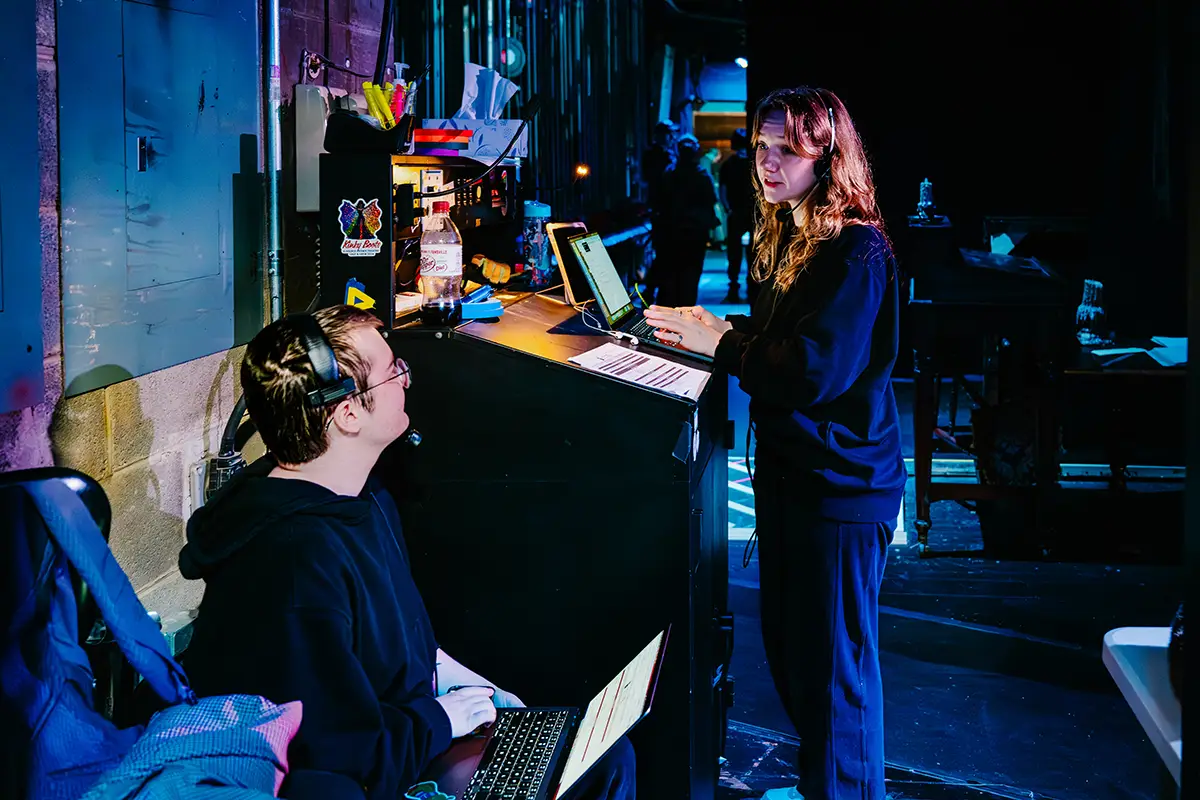

In both acting and design, from the undergraduate through Master of Fine Arts (MFA) level, students learn not only in the classrooms and world-class theatre facilities on the Knoxville campus but in the community and in positions across the country.
Playing the Part
Course catalogs and brochures don’t fully prepare theatre students for the opportunities at the University of Tennessee, Knoxville.
“Students are surprised how quickly they’re thrown into the deep end—in the best way,” Martin said. “They’re performing in mainstage CBT shows, developing new work in the Lab, working in brand-new spaces like the Jenny Boyd Theatre, and collaborating across campus with designers, artists, and technologists. People arrive excited, and then realize the scale of what they actually get to do is even bigger than they expected.” (See UT’s Three Theaters.)

UT also stands out as one of only 13 universities to have its own professional theatre associated with the League of Resident Theatres (LORT), the country’s largest professional theatre association. By being a LORT D company, the Clarence Brown Theatre (CBT) allows students to work with professionals under the association’s contracts.
“UT’s MFA in acting keeps landing in the top-25 MFA performance programs in the world because it doesn’t just teach the profession—it drops students straight into it,” said Martin, who also serves as the artistic director for the Clarence Brown Theatre company. “The program is built around an unusually deep partnership with the CBT that isn’t adjacent to the training, but central to it. MFA actors rehearse and perform alongside working professionals, learning the pace, discipline, and standards of the field by living inside a real producing theatre.”
“That daily immersion is paired with tough, conservatory-style studio work in acting, voice, movement, and classical and contemporary text, all within the resources of a major Research-1 university,” he said. “The cohorts are small and highly selective, which means close mentorship and a true ensemble culture. Add full financial support—so students can focus on craft instead of debt—and a track record of alumni working on Broadway, in top regional theatres, on tour, and on screen, and you’ve got a program that keeps attracting national and international attention.”

That is the type of experience acting Assistant Professor Shinnerrie Jackson (MFA ’08) appreciated when she was a student. “I enjoyed that I would get rigorous studio time and also be able to take that into a professional setting and make connections with different people in the industry,” she said.
In recent years, for example, the 2024 production of Knoxville brought Tony Award–winning songwriters Lynn Ahrens and Stephen Flaherty to UT, as well as actors such as Jason Danieley performing alongside students. In 2025, Hunter Foster directed The Play That Goes Wrong.
Alumni also return to campus to work with students in the classroom. During the Play Analysis course, for example, students read works by more contemporary playwrights. “We bring in alumni and friends that we have in the industry who have been in those plays,” Jackson said. “We did a musical called Soft Power, and we brought in our alumni Conrad Ricamora (MFA ’12).” In 2025, he was nominated for Tony for his role in Oh, Mary!
Tramell Tillman (MFA ’14), who won a 2025 Emmy as Best Supporting Actor in Severance, has been a guest teacher in UT’s Diverse Plays and Playwrights course.
Faculty members have dual appointments with the theatre company and also work in theatres across the country, bringing current experience back to the classroom, as well as opportunities for students. Jackson, who teaches courses from the introductory to the graduate level, performed in three regional theatre productions last year.
Creating a Design
While UT’s acting alumni are the most visible, undergraduates in design/technology and MFA students in costume design, lighting design, scenic design, and sound and media design also are well prepared to win roles in venues across the country.
“Many of our students become technicians at theater companies, live entertainment concerts, churches, film and recording studios … Everything that we do is transferable to lots and lots of different media, “ said sound and media design Professor Joe Payne. “Our students absolutely have the skill set to get into any of the live entertainment industries.”
“Themed entertainment is huge right now,” he said, with designers and technicians at venues such as Dollywood and Disneyland. In the past decade, museums also have gone beyond showing content to telling stories that require sound and video.
Payne is a professional sound designer, composer, and digital media designer who has worked across the country. For more than 20 years he has worked at the Utah Shakespeare Festival, what he considers his creative artistic home.
“I love creating spaces and combining sounds and music at the same time to create interesting spaces, he said. “I love taking Shakespearean themes and making them feel modern and feel like they connect with the audience.”
“Any time that we as faculty go out of town to do these projects, it’s exciting that we get to learn new things, work with new people, gain new skills, but I also take students with me all the time,” he said.
As an undergraduate, Lucas Swinehart (’23) worked as a sound mixer at the Utah Shakespeare Festival, and he went on to work on the US tour of Mrs. Doubtfire. Current MFA student Elisabeth Dupuy will work with Payne this summer on the musical She Loves Me at the festival and bring that experience back to campus.
Working on productions off campus gives faculty experience with different equipment, different methods of producing, and different processes. “I bring that back to the classroom all the time to teach students new ways of doing things and new ways of thinking about things,” Payne said. One of those experiences led him to suggest UT use a collaborative app called Cuelist for scripts, which allows designers, the stage manager, and everyone else involved to see the cues and notes.
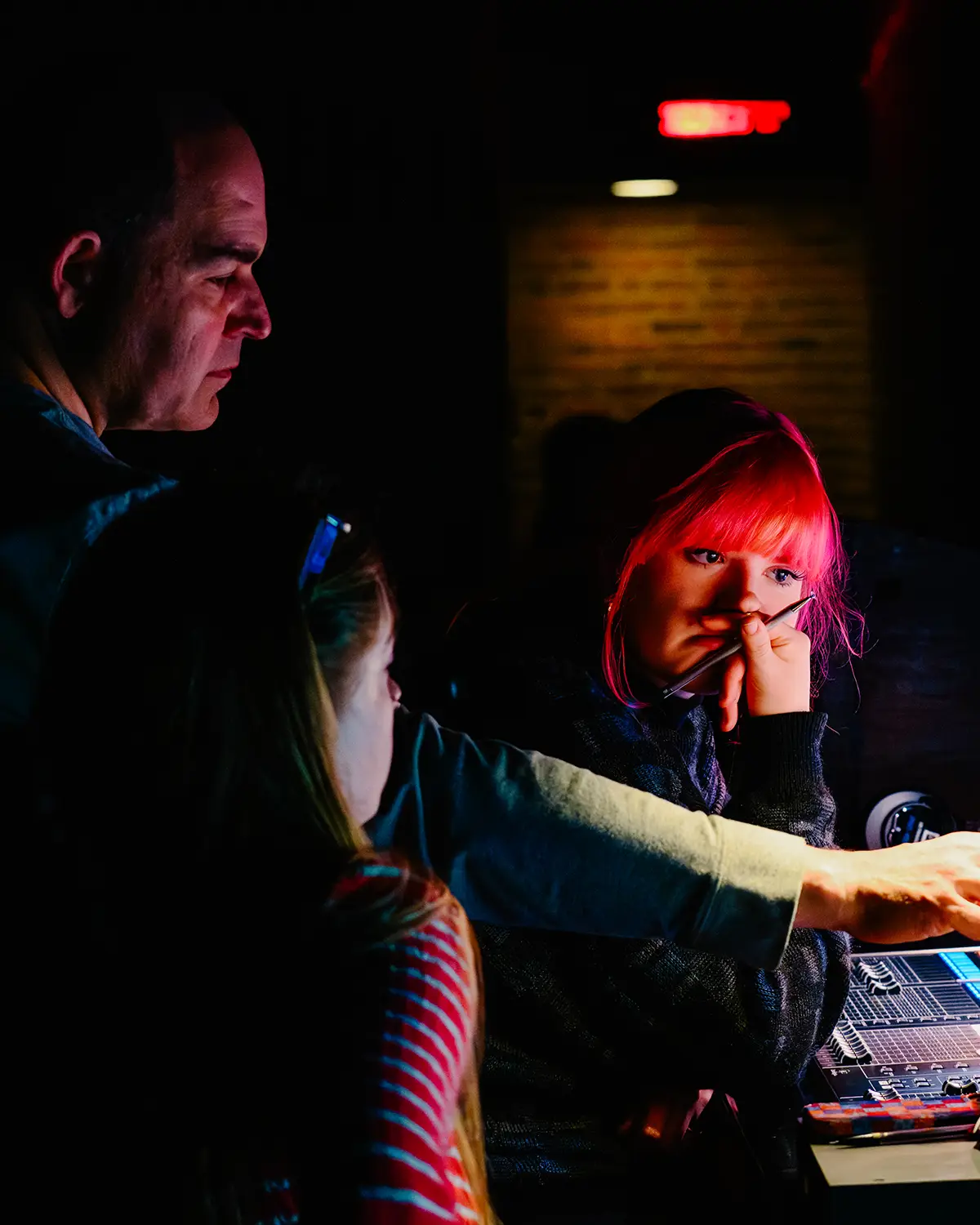
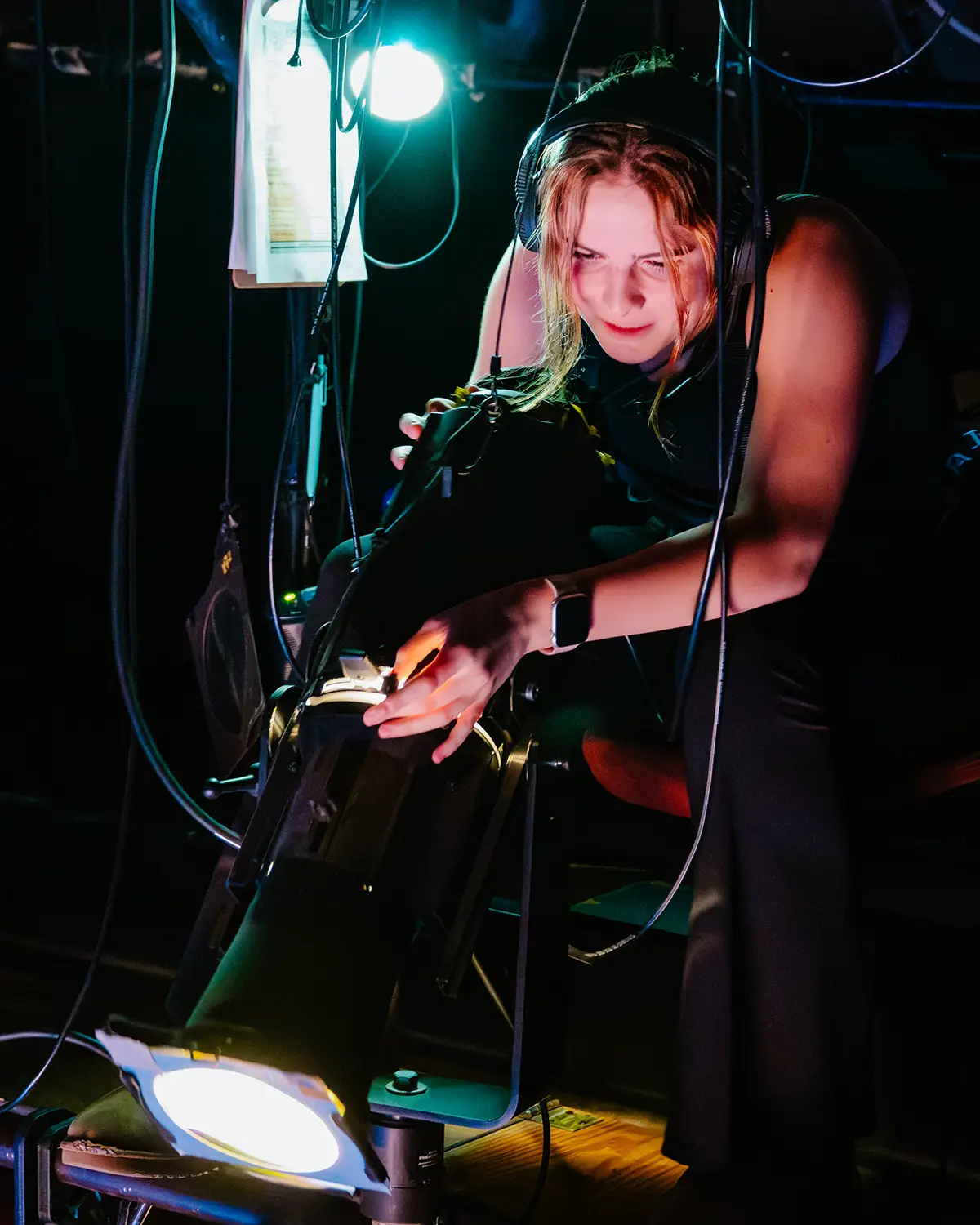

Classrooms on the Knoxville campus provide hands-on opportunities too. Lighting Professor Kenton Yeager pioneered a 1:6 scale—Barbie sized—“Yeager Lab” that allows experimenting with sound, media, and lights inside a Walters Academic Building classroom without climbing any ladders.
“We have an undergraduate space that is second to none in the country,” Payne said. “Students can create content in the computer lab, create video, create audio sources, and then walk next door into the media lab and just express them three dimensionally in those spaces.”
The theatre department’s sound and media courses also are part of a new interdisciplinary Visual and Interactive Storytelling program in the College of Arts and Sciences, leading to careers in areas such as podcasting, narrative game and media design, and immersive virtual-reality experience creation.
Additionally, internships, independent study, some paid volunteer positions, and other opportunities allow UT students to gain experience through local high schools and churches, River and Rail Theatre Co., and WordPlayers Theatre Co. Faculty also connect students with summer stock seasonal productions.
“One of the biggest strengths of our program is its flexibility and its individual mentorship,” Payne said. “We get students involved in production, we mentor them, we guide them. They actively do real-life projects.”
Dressing Up
UT students work alongside professional theatre production staff too.
In the basement of the Clarence Brown Theatre, the costume shop creates, acquires, manages, and maintains the attire for up to eight shows a year. More than three rooms of racks and bins filled to the brim are supplemented by off-site storage for every item imaginable, from wigs to boots.

For A Christmas Carol or plays set in modern times, the university may have most of the costumes in stock, but they always need to make some new for changes in actors’ sizes and the materials wearing out. For Sense and Sensibility, the costume shop made about half of the dresses, coats, and hats. Design work for Cabaret, which opened in February, began the previous August.


Melissa Caldwell-Weddig made hats for Broadway productions before moving to Tennessee 17 years ago and becoming UT’s costume shop manager. She teaches Millinery for the Stage as well, and one of the students’ projects from that course will be used on stage.
From cutting patterns based on costume renderings to final fittings, the costume staff does it all.
“We are always working on ways to incorporate students into the process and to give them valuable experiences while also keeping our quality,” Caldwell-Weddig said. Inside the costume shop students may work with equipment including standard sewing machines, a strip straw machine for sculpting hats, or a state-of-the art 10-needle embroidery machine.
Tori Niemiec, a second-year costume designer in the MFA program, was in the costume shop one January day combining color theory and chemistry as they dyed fabric to get just the right shades of black and pink for a couple of Cabaret costumes.
Niemiec began in another master’s program but came to UT for education that would push them to grow in interesting and dynamic ways. “The program is set up for you to succeed and gradually scale upwards in terms of how much you can take on,” said Niemiec, who was the costume designer for Sense and Sensibility at the CBT.

A Role for Everyone
The UT Department of Theatre isn’t just for majors and minors. In addition to numerous courses that fulfill Volunteer Core curriculum requirements, productions have open auditions. That means a cast may include professionals, theatre majors, alumni still living in the area, and others. CortneyJo Sandidge, chief strategy officer for UT’s Center for Global Engagement, is a cast member for You Can’t Take It With You this spring at the CBT.
Undergraduates also can learn how to help behind the scenes as dressers, preparing actors for the stage, assisting with quick changes, and caring for the costumes afterward, including steaming and pressing.
“We’ve had quite a few people move on to do that professionally in New York, and we’ve got someone on cruise ships right now who’s running wardrobe on a show,” said Caldwell-Weddig. “It’s a vital part of the theatrical community.”
By Amy Beth Miller
Select photos courtesy of the UT Department of Theatre and Clarence Brown Theatre



UT’s Three Theatres
With the recent opening of the Jenny Boyd Theatre (JBT) on the grounds of the former Carousel Theatre, the University of Tennessee, Knoxville, and Clarence Brown Theatre (CBT) Co. offer a full range of performance spaces in which students can grow.
“The Jenny Boyd Theatre is our new flagship space—designed for big, ambitious storytelling and contemporary production,” said Kenneth J. Marin, head of the Department of Theatre. “It gives our MFA actors experience working in a cutting-edge professional venue, tackling complex technical environments, and performing for large audiences. It’s a signal that UT and CBT are investing boldly in the future of theatre training.”
“The Lab Theatre is where our actors get to stretch and take risks,” he said. “It’s a smaller, more experimental space for new plays, devised work, and actor-driven projects—lots of reps, lots of discovery. It’s where students sharpen their artistic voices before stepping onto CBT’s main stages,” he said.
As a professional company associated with the League of Residential Theatres (LORT), the CBT serves as an anchor for UT’s theatre program. “The Jenny Boyd Theatre lets students work at full regional-theatre scale, while the Lab Theatre gives them room to experiment and lead. Together, they create a training ecosystem that mirrors the real world—big stages, small rooms, and everything in between,” Martin said.
UT faculty and staff had a hand in the new theatre from conception on, creating a space that is flexible, intimate, and state-of-the art.
Sound and media design Professor Joe Payne said the sound system is as flexible as the space, with a Meyer Sound speaker system for an immersive experience and DiGiCo mixing console, the same brand Broadway shows use.
“We very specifically wanted systems that emulate Broadway houses, regional theaters, and high schools and churches, so that students have experience with those systems at all of those levels, and so that they can go out into the real world and say, ‘Oh yeah, I’ve used that before,’” said Payne, who also served as the sound and production designer for the first show in the JBT, Cabaret.
By Amy Beth Miller

